
Where AI Actually Fits in Your TBM Program
Most TBM programs are asking the wrong question about AI. The question isn't whether to automate the full model. It's which bottleneck AI removes from your program first, and the answer depends on what's currently grinding your team down.
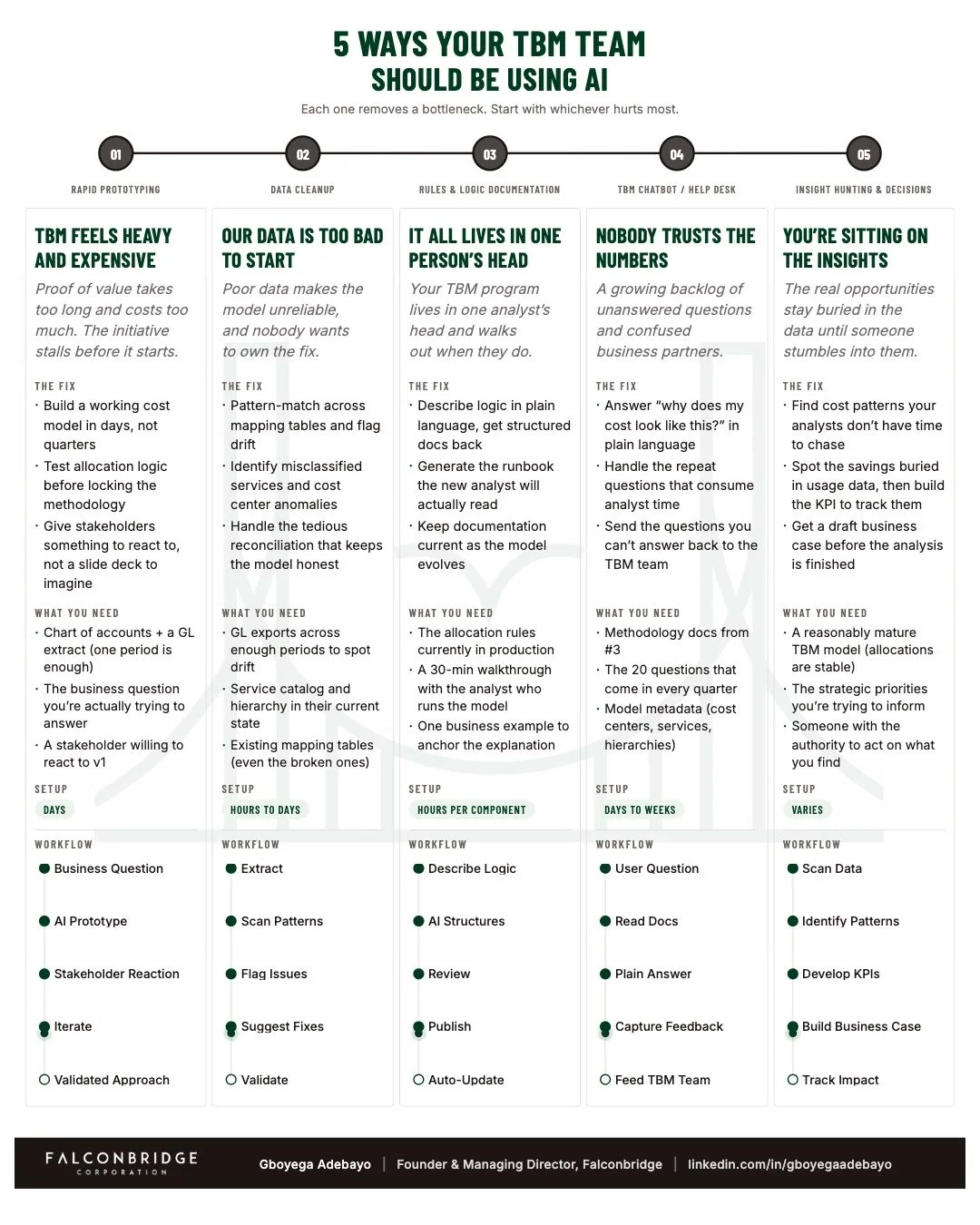
A fully AI-automated TBM model is where the software roadmaps point. It may arrive. In the meantime, something less ambitious is already working: five practical applications, each removing a specific bottleneck, all doable with a small team and existing tools. The spirit is closer to the proof-of-value prototypes TBM teams used to build in Access and Excel than to platform automation.
These five aren't a menu of equally good options. They're common pain points. The right starting point isn't the most exciting use case. It's the one that's stalling the team you have right now.
1. Rapid prototyping: using ai to build a working cost model in days
When proof of value takes too long
A familiar stall pattern: a TBM initiative spends two quarters debating allocation methodology before anything goes in front of a stakeholder. By the time v1 exists, the executive sponsor has moved on or the budget cycle has closed.
AI prototyping flips that sequence. Build a working cost model in days using the chart of accounts and a single GL extract. The output isn't right yet. It's directionally close enough that a stakeholder can react to it, and stakeholder reaction is the only way allocation logic actually gets pressure-tested. The thing you can't get from a slide deck is someone pointing at a number and saying "that can't be right." That's the moment the model starts to converge.
The mistake to avoid: treating v1 as a deliverable. It's a conversation starter. The output is the stakeholder reaction, not the model itself.
2. Data cleanup: ai for mapping table drift and cost center anomalies
When the data is too messy to start
Most TBM programs don't stall on methodology. They stall on data. Cost allocation tables have drift in them. Services have been renamed. Cost centers have been merged or retired. Mapping logic written eighteen months ago no longer matches the GL structure it was built against.
Cleaning this manually is the work nobody on the team wants to own. AI is genuinely good at it: pattern-matching across mapping tables, flagging drift, surfacing misclassified services, identifying cost center anomalies that humans miss because they look reasonable in isolation. The output is a list of issues a human still needs to validate, which is the right division of labor.
The prerequisite worth naming: enough periods of GL exports to detect drift. One period isn't enough. The pattern only shows up in the comparison.
3. Rules and logic documentation
When the model lives in one analyst's head
This is the bottleneck most programs underestimate until they have to onboard a new team member or hand the model off to a successor. The allocation logic is documented in code. It is not documented in a way that anyone other than the analyst who built it can read and understand why a specific dollar lands in a specific bucket.
This is the use case where AI is most useful in a way the team can feel within a week. Describe the logic in plain language during a thirty-minute walkthrough with the analyst who runs the model. Get structured documentation back. Use one real business example to anchor the explanation, and the output becomes a runbook the next analyst will actually read.
The deeper benefit is downstream. Documentation that stays current as the model evolves is the precondition for use case four.
4. TBM chatbot and help desk
When nobody trusts the numbers
Every TBM team has a version of the same problem. Business partners can see their costs in the dashboard. They don't trust them. So they email the TBM team to ask "why does my cost look like this?" The TBM team answers the same twenty questions every quarter, in slightly different forms, and that work consumes the analyst time that should be going to insight.
A chatbot trained on the methodology docs from use case three answers the recurring questions in plain language. The questions it can't answer get captured and routed back to the TBM team, which is its own signal of what the model still doesn't explain well enough. Analyst time goes to the questions worth answering instead of the ones that have been answered a hundred times before.
This one is sequencing-dependent. It doesn't work without the documentation foundation. Trying to build it on top of methodology that lives in one person's head produces a chatbot that confidently makes things up.
5. Insight hunting and decisions
When you're sitting on the insights
The mature-program problem. The model is stable. Allocations are reasonable. The data is clean enough. And the insights are still buried, because the team's time is consumed by running the model rather than reading what the model is telling them.
This is where AI gets useful for finding things human analysts don't have time to chase: cost patterns buried in usage data, savings opportunities that only show up when you look across enough dimensions, the draft of a business case that gets a decision started before the analysis is finished. The output is a starting point for a judgment call, not the judgment itself.
The prerequisite is the one that's hardest to fake: someone with the authority to act on what AI surfaces. Without that, this use case produces a backlog of findings that no one owns.
How to pick yours
Each of these removes a different bottleneck. The right starting point depends on which one is yours.
Start with rapid prototyping if the program hasn't shipped a model yet. The risk to remove is methodology paralysis.
Start with data cleanup if the model exists but no one trusts the numbers. Everything else gets undermined by data quality issues no one has time to chase.
Start with documentation if the model works but lives in one person's head. The operational fragility risk is real, and documentation is the gate to everything downstream.
Start with the chatbot if the team is buried in the same twenty questions every quarter. The constraint to relieve is analyst capacity.
Start with insight hunting if the model is mature and the data is being read well but acted on slowly. Decision latency is the bottleneck closest to actual financial impact.
The infographic shows the order of dependency, not the order of importance. Documentation makes the chatbot possible. A clean model makes insight hunting credible. The program doesn't need to walk the path in sequence. It needs to start where the pain is loudest.