
prove the payoff before you spend the budget
Leadership wants the business case by Friday. Nobody has the current-state number to measure the payoff against.
—
Every project claims a payoff on the approval slide, and nobody goes back to see if it showed up.
—
Last year’s business case used one method. This year’s uses a different one, so nothing compares.
—
The AI business case is due Friday, and there’s no baseline to build it from.
A payoff number with nothing underneath it
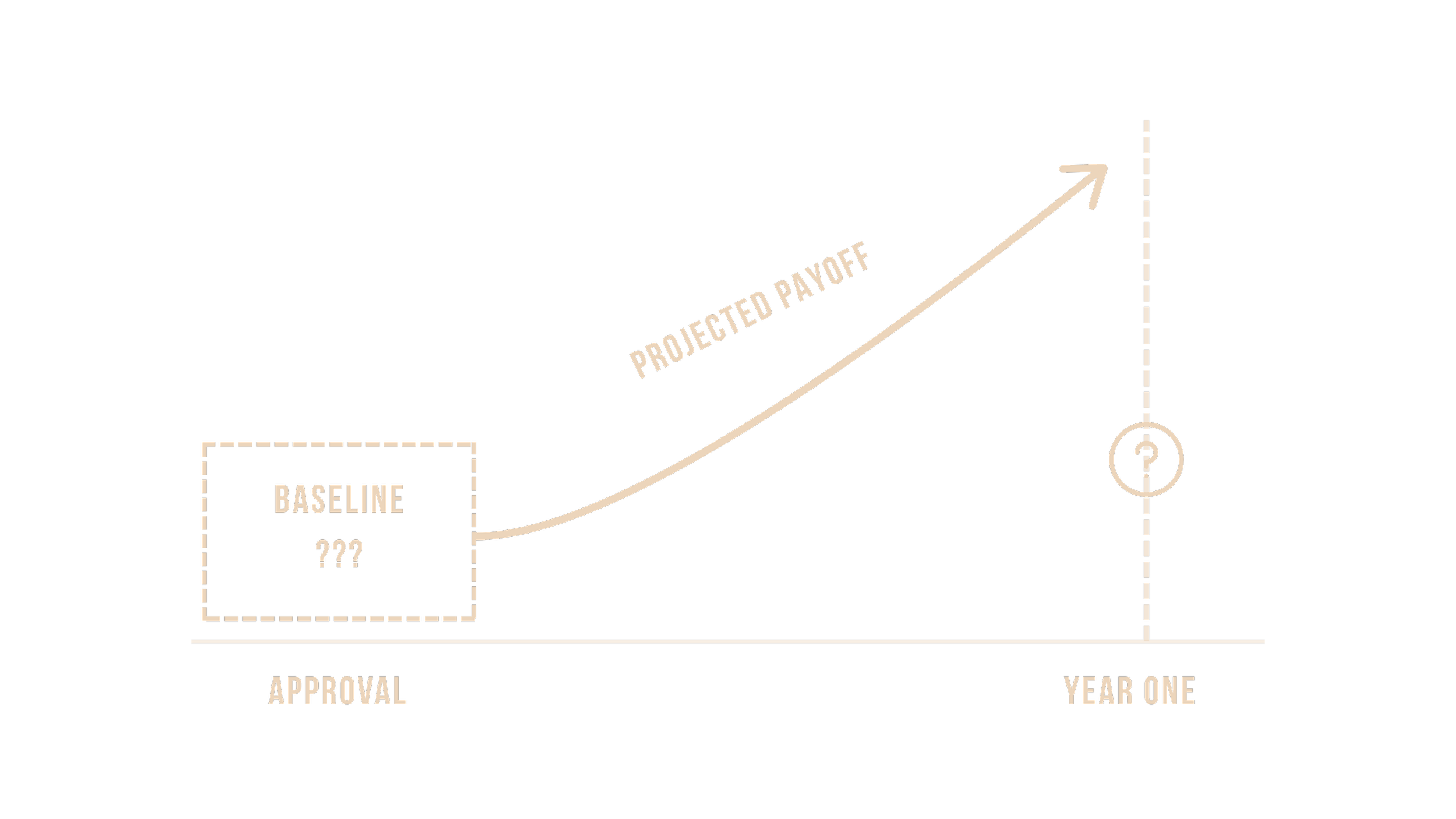
Most technology business cases get built the same way under a deadline. Someone projects the future state, picks a payback period that clears the hurdle rate, and calls it done. What's usually missing is the other half of the comparison: a real, current-state cost baseline to measure that payoff against once the investment is actually live. Without it, the projection isn't necessarily wrong. It's just unverifiable.
That gap doesn't show up at approval. It shows up a year later, when someone asks whether the investment delivered what the case promised, and there's nothing left to check it against except the original slide. The case gets approved on the strength of the story, then quietly forgotten once the deadline that produced it has passed. The next request starts from the same zero.
T H E O T H E R H A L F O F T H E C O M P A R I S O N
WHAT THE CASE SHOWS VS. WHAT GETS CHECKED
E L E M E N T
CURRENT STATE
METHOD
FOLLOW-UP
W H A T T H E C A S E U S U A L L Y S H O W S
W H A T ‘ S M I S S I N G
A rough estimate, built fast to hit the deadline
A fully loaded baseline; infrastructure, labor, licensing, support
Whatever assumptions get the number past the hurdle rate

One method, applied the same way to every investment case
Nothing scheduled once the case is approved
A scheduled return to the baseline, to see what actually happened
"A payoff number nobody checks again was never really a projection. It was a guess with an approval date."
WHAT IT TAKES
Not a faster spreadsheet for Friday's deadline. A baseline the payoff can still be measured against a year from now.



BUILD THE BASELINE FIRST
Build the current-state baseline before the investment case gets written: the fully loaded cost of what exists today, so the projected payoff has something real on the other side of the comparison.
ONE METHOD FOR EVERY CASE
Apply one consistent method across every business case that crosses the same desk, so a payback period from one investment can actually be weighed against another instead of each one inventing its own math to clear the bar.
sequence the cuts
Put a date on the calendar to return to the baseline once the investment is live, and check whether the number that got it approved actually showed up.
This is where TBM earns its place in the exercise: turning a one-time approval document into a number somebody is still accountable for a year later.
When the investment sits outside the technology budget entirely, the same three steps run under Enterprise & Decision Cost Modeling (EDCM) instead.
Most requests start at the deadline, not the baseline. The baseline is usually the part that doesn't exist yet, and it's the part that takes the real time.
WHY WE CAN SAY THAT

01
02
03
We’ve built baseline and payoff models from inside finance and technology functions that had to defend the number to a CFO, not from a deck built to win the room.
We’re tool-agnostic on the model itself. Whether the baseline lives in Apptio, ServiceNow ITFM, Serviceware, Nicus, a spreadsheet, or something purpose-built for the case, the method is what travels, not the software.
We don’t sign off on a payoff number until there’s a date on the calendar to check it against the baseline. What travels across every engagement is that the check actually happens.
IF THAT ISN’T THE ONE YOU WERE HANDED
01


PROGRAM OWNSERSHIP
& DECISION RIGHTS
The tool went live. Nobody’s
decided who owns what it says.
02
Six assignments, one practice behind all of them. If this isn't the one you were handed, here are the other five.

cost optimization & profitability
The bill still reflects last year’s
budget, not what anyone used
this year.
03
IT service costing & chargeback
The last round of cuts held for two quarters, then the spend crept back.
04

PORTFOLIO CONSOLIDATION
& RETIREMENT
Everything on the list looks
essential until someone has to
defend keeping it.
06

M&A INTEGRATION &
RUN-COST CONTROL
Two of everything, and the
synergy number is already on
a slide.
bring us friday’s business case
Thirty minutes with someone who's built these before. Send the case that's due, and you'll leave with a read on whether the number underneath it would survive being checked again in a year.